Mar 24, 2010

Did The Doohickey

Today I completed a further step towards getting my KLR6500 back on the road. I replaced the balancer chain idler pulley. This part is commonly referred to in the world of the KLR650 as the "doohickey."

I won't bore you with describing the whole procedure. It can be found here:
www.klr650.marknet.us

Something not updated in this procedure is the new spring design pioneered by Mike of Eagle Design and Mfg. I bought my kit, including the custom wrench and rotor puller, from A Vicious Cycle in New Dundee, Ontario. Great place for dirt bike and dual sport enthusiasts.

www.aviciouscycle.ca

The new torsion spring is not discussed in the above procedure. For that, the instructions can be found at Left Coast KLRs.

http://leftcoastklrs.com

Here are a few pictures from my own experience. I should say that with the above instructions, there were no surprises whatsoever.

My setup - I used ratcheting straps to tie the motor down
as a lot of torque is necessary to remove the rotor inside.


Close up of the left side strap. I removed the strap from
the ratcheting mechanism to thread it behind the oil
line which feeds the head.


Wider view- the back of a pickup truck is the perfect
work area. D-rings to hold the motor right at waist level.


This view shows my work lights. Plenty of light!


Left side cover removed showing the stator. The
rotor is still on the engine.


Torque on the rotor bolt is 130 ft.lbs. This custom
wrench holds the rotor/engine from turning.
Worked great!


Here is my old doohickey on the left. A welded part.
New doo on the right is machined from solid billet.


Vacuuming off engine before removing second
engine casing in order to access old spring.


This original spring, at 45,000 kms, has lost
all of it's pulling ability.


The engine casing has been drilled out to accept
the new torsion spring - shown.


Inner engine casing, torsion spring, and new
doohickey are applied. Using tack lifter
to stretch spring into place.


Here the spring is in place, and pushed back into the
groove on the doohickey. No more weak extension
spring or welded part.


Re-tightening the rotor bolt.

Mar 7, 2010

First Ride of 2010

It felt great to be riding the motorcycle today. It was unseasonably warm and I took full advantage. Not a big ride, but a very satisfying one. Can't wait for the next one.


Feb 2, 2010

2010 World of Motorcycles Expo

In the midst of a Canadian winter. Bikes are parked and we can only dream of rides to come. But wait, we can also get together to talk about and look at motorcycles at the numerous motorcycle shows that take place in the winter time.

Here in London Ontario, the World of Motorcycles Expo is coming up soon. February 19th - 21st at the Western Fair Agriplex.

I will be running the show booth for the London Motorcycle Ride for Dad, and will be displaying the motorcycle I rode in the 2009 Iron Butt Rally.

Jan 21, 2010

This is an iPhone test.

This is a test of blogging via iPhone. This test will determine how accurate text entry is, and whether the forms work.

Sep 8, 2009

My Honda ST1100 is amazing for putting up with the crap I throw its way. It just shrugs it off. Simply amazing.

The bike now has 428,800 kms on the clock. Ahh, the open road.

It has just completed its third Iron Butt Rally. During the ride down to the start in Spartanburg South Carolina (1300km), the rally itself, and the ride home (3500km) I have clocked over 22,500 kms. I have done this without an oil change. This is the second time I have competed in the Iron Butt without changing the oil in between somewhere.

Before leaving, I went down in deep mud and tore the windshield off. I rode the iron Butt with the windshield taped on with duct tape. Incidentally, duct tape does not stick well in temperatures greater than 120F. Twice it came loose, the second time it knocked me square in the face before landing on the interstate behind me. A truck clipped it before I could retrieve it but it did not shatter. It is time for new plastic.

Thanks to Tomas of the Honda ST Owners club for helping me tape it back on the first time in Texas.

During the rally, the bike shut down due to a faulty vacuum shutoff valve. I bypassed the valve, forgetting to block the vacuum line. I rode it home this way, running rough all the way. That is what can happen when you are tired.

Also during the rally, I got the bike stuck in Louisiana Bayou mud. So badly that the front fender was caked up with it. The mud was so hard it felt like I had the front brakes on. I walked the bike using its own power for maybe 100 ft or so and the front tire was hot and smoking! I had to remove the fender by flashlight and knock the mud out.

Another thanks goes out to another Honda ST Owners Club member - Mike Turley of Montana. Thanks for giving us a place to stay for the night as we were passing through!

I have new spark plugs, air filter, and fuel filter waiting to go in not to mention fresh oil and a filter. It deserves it.


Rural Montana


Tied down on the Lake Express Ferry


Shut down in Rural Alberta


On The Ferry To Martha's Vinyard


Port Angeles Washington - In The Extreme
North West Corner Of The State

Aug 24, 2009

Iron Butt Rally Starts In The Morning

At 10AM Monday morning, I depart on the 2009 Iron Butt Rally.

Due to rally regulations, I will not be permitted to post to this site during the rally. Nor will my SPOT tracker be active in this public forum to protect the integrity of the bonus locations.

I am looking forward to the rally, and to writing about it afterwards.

To follow the rally, you can read daily updates on the Iron Butt Rally website.

Aug 21, 2009

Arrived In Spartanburg

I am here in Spartanburg, South Carolina. It is Friday, August the 21st. The rally starts on Monday.

No official functions on the roster today. Just doing a few little things to make sure I am ready. I will likely do some mapping work to prepare myself for plotting bonuses for the rally. Also a nap is in order for this afternoon. It was a long day yesterday riding down here from London, Ontario.

The bike suffered a fuel starvation issue during a long hot slog through a clogged interstate highway. Neil Ward's KLR650 also was acting up during the ride down. His temperature gauge is faulty.

Sal Terranova from Buffalo rode with us on his ST1100. All three of us are in the rally. His bike was the only one that did not act up. I must say thanks to Sal for providing me with a few camera memory cards and a Camelbak drinking system for my use during the rally. I will also take this time to thank Inglis Cycle Centre in London Ontario, who have been generous in my preparations leading up to the rally.

Due to the wishes of the rally organizers, this event will maintain its amateur non-commercial nature this year. This means that I must cover up or remove any companies decal that may be on the bike. Another duty I will be performing over the next few days.

The 1300 km I rode yesterday to get here is the longest ride I have taken all year and I feel it. Oh boy...

Aug 20, 2009

coolant problems on neil's bike near pittsburgh
Thane Is Mobile
----------------------------------------------------------------
Sent by Text Messaging from a mobile device.
Envoyé par messagerie texte d'un appareil mobile.
----------------------------------------------------------------

A Picture/Video Message!


A Picture/Video Message!, originally uploaded by tsilliker.

Aug 2, 2009

It's Getting Closer

It's August 2nd. In just a little over two weeks, I will be heading to Spartanburg, South Carolina to join 99 other crazy individuals participating in the Iron Butt Rally. It is getting more real and more menacing in my mind. I have ridden this rally twice before and yet that is not enough to quell the nervousness.

A tremendous personal challenge. Not just of one's riding skills. Riding it is almost the easy part. No, the real challenge is in choosing where to ride. From the massive list of "bonuses" or destinations, one must decide which ones to ride to. Of course some are worth more than others, and some are "sucker" bonuses, designed to trick the rider into making a bad decision.

Go for the big ones. Sounds easy, but sometimes, a string of medium ones add up to the same. Tricky. Very tricky. I'd like to think I am good at it, but in 2005, 24 other people were better at it than me.

Am I ready? Well I will likely do some mapping work beforehand to prepare. Alas, the latest version of Garmin maps is backordered at dealers and unavailable. The bike is pretty much ready. A few little things need to be done, but it is in good condition. No nagging problems with the machine to distract or worry.

I am the holdup. Not having done many long rides this year, I am concerned I will be able to keep up. Log in here and and at ironbuttrally.com to follow along.

Jul 21, 2009

South Africa

Recently, I completed a five week work assignment in South Africa. I was in the city of Pretoria. For North Americans, this is an interesting place to visit, not only because of the history and the wildlife, but also because they drive on the left side of the road.

I was lucky enough to do some driving and riding during my time there. Temperatures were quite pleasant despite the fact that it is their winter right now.

I would like to thank Riel Smit and especially Peter Short. Peter's generosity in lending my his BMW R1150RT was very much appreciated. It helped stave off the motorcycle withdrawal I was beginning to experience, and it gave me the chance to experience South Africa in a way that was very enjoyable and familiar to me.

Familiar, except for the fact that one must always remember what side of the road you must be on!

I was there mainly to work, but found the time to enjoy riding. SA of course has a troubled past, and despite the fact that there is hope and optimism amongst residents for a brighter future, there is high unemployment and crime there. Most properties have fences topped with barbed wire surrounding them. Sometimes it looks as if one is in a prison.

It would certainly be a shame not to experience everything possible, and I did my best. I even traveled to neighboring country Botswana. This to rehearse for perhaps a longer multi-country tour one day. One day.

Here are a few pics and videos.


The very nice BMW R1150RT


Little dualsport that was running around called the Wildfire. I don't know the origins of this make.


Visit to the Apartheid Museum.


Two stroke Suzuki GP125.


Jonway cruiser. This is a Chinese made bike - 250cc. This is the first bike I saw in SA after arriving there.


My trip to Botswana.


Impala crossing!

May 16, 2009

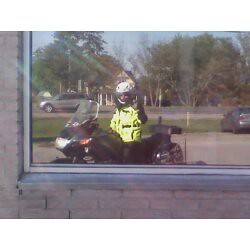
Visibility is important!
Thane is mobile
----------------------------------------------------------------
Sent by Text Messaging from a mobile device.
Envoyé par messagerie texte d'un appareil mobile.
----------------------------------------------------------------

A Picture/Video Message!


A Picture/Video Message!, originally uploaded by tsilliker.

James Bay via KLR article - Motorcycle Mojo Mag

My article on riding the Route du Nord via KLR is in the June 2009 edition of Motorcycle Mojo magazine.

You can find it here.

May 14, 2009

Mileage Milestone

The Honda ST1100 recently reached a major milestone and it seemed like a good time to do a little review of where the bike and I have been.

Accepting the keys

I purchased the machine in March of 1998 from Hully Gully. I knew from my days with my Honda Shadow that I wanted to do more traveling, and the ST was my choice. I fell in love with the colour when I saw it on the showroom floor.

The bike was all I hoped it would be. Within a month, I had done my first SS1000 ride with the bike. It was a cold ride, and I thought I was prepared. I knew enough to have a heated jacket liner, but I was still frozen. It WAS April after all, and riding through the night was frigid.

I was successful, however. And I was hooked. It wasn't long before I was planning longer rides in the Iron Butt Association extreme category.

In 1999, I set a record crossing Canada in 65 hours and two minutes. The previous record was 84 hours and change by a fellow named Roy Eastwood. I assisted the IBA in setting this up as an official ride called the Trans Canadian GOLD.

I rode the bike to Edmonton in 1998, 1999, and 2000 to participate in the Alberta 2000 rally. This is an immense ride. 3500km each way, plus the event's 2000 km. All this is the span of six days.

I once again crossed Canada in even less time in 2001, using a fuel cell and a catheter setup. My elapsed time was 59 hours and 45 minutes - beating my own record. I also rode the Iron Butt Rally in 2001, placing in 32nd place with a gold medal. Very good in this competitive field.

In 2002, the bike was rear-ended hard on the highway and I was thrown off. There was over $6000 dollars damage to the bike, including a bent subframe. It was repaired with no apparent lasting effects. I had a sore shoulder but was otherwise unhurt, thanks to my armoured riding suit.

Many other trips followed. Including Mexico, Key West, and St. John's Newfoundland. I continued to do solo and competitive long distance rallies.

The bike was racking up big mileage but showed little signs of slowing down. Today, it uses somewhat more oil than when new, but I wouldn't hesitate in riding it across the country. Eventually, things were showing signs of wear. Parts I have replaced include: Steering head bearings, rear differential bearings, u-joint, one intake camshaft, all of the fork internals, three timing belts, water pump (not a failure, just on spec), water hoses, thermostat, clutch, and a couple of starter solenoids.

I was stuck on Cochrane, Ontario, when a starter solenoid failed, and had to take the train and bus back home in order to pick up my truck and trailer and drive 12 hours north to retrieve the bike. Quite an ordeal. That was 2002 when I was attempting a back to back ride of Canada. I had already completed the ride from Halifax to Vancouver and I was on my way back.

I successfully rode across Canada back to back on the clock in 2004, establishing a new one-way record of 59 hours and 36 minutes in the process.

I rode the Iron Butt once again in 2005. Increasing my place in the finishing order to 25th place and again with a gold medal. Very pleased with this finish.

Each winter the bike gets a thorough going over. All fluids get changed - brakes, clutch, coolant, rear diff oil, fork oil, as well as fuel filter, air filter, spark plugs, and of course a carburetor synch and valve clearance check. It's a lot to do, but it's worth it.

In 2007, I had the motorcycle tattooed on my arm.


Now I am looking forward to riding the 2009 Iron Butt Rally with this bike. The bike has been nicely updated with all the things previously mentioned. I even have a new seat courtesy of my friend Sal Terranova from Buffalo. I will be sure to post results and hopefully a few updates during the rally.

And so here it is, the latest milestone in a long series of milestones in the ongoing story of this motorcycle. I am so very impressed with this machine, the Green Hornet.

Apr 15, 2009

Riding The Rock(s) - The Newfoundland Rail Trail


Helping to pick up my riding companion’s motorcycle for the second time that day, I seriously began to doubt if we would ever make it. We were only one day in to our off-road excursion all the way across the province of Newfoundland.

It was a long time coming. Planned for several years, we were finally on the trail after riding our 650cc dual sport motorcycles three days from southern Ontario.

This trail was many years in the making, too. You might say it took over 100 years and countless millions to construct it. The T’Railway Provincial Park, part of Canada’s national trail system, exists on the former Newfoundland railway system.

The subtext behind this story and beneath our wheels, goes something like “the rise and fall of the Newfie Bullet.” The “bullet” nickname was most definitely tongue in cheek. The narrow gauge railway wound its way around and through obstacles in a manner unlike modern railways with their welded rails, and gentle slopes and turns.

Originally, Sir John A. Macdonald offered to build Newfoundland a railway, if they agreed to join confederation. He was rebuked, and the railway never got off the ground until 1881. The homegrown rail system brought a sense of national pride and economic development to the colony, opening up the interior and bringing a more diverse economy to this land of fishing villages.

The Newfoundland Railway became part of the CNR when they joined confederation in 1949. Perhaps the promise of a new highway system might have lured voters. The completion of the Trans Canada highway all the way across the province in 1965 was the death knell for the troubled railroad.

The narrow 3’6” gauge, chosen for reasons of economy, ultimately became more expensive to maintain. Equipment brought to Newfoundland had to have their trucks – the wheelsets they ride on – changed to match the uncommon gauge. Also, the decision to route the rail line over the mountains known collectively as the Gaff Topsails resulted in regular slowdowns in the winter when snow would often shut the line down for days.

The last locomotive wheels turned in 1988, with trains assisting in the dismantling of the rail lines. With the conversion of the winding railbed to recreational use, the right of way is still bringing economic diversity to the province in the form of tourism.

With only an outsider’s knowledge of the trail, we knew we were at a disadvantage. Navigational help was in the form of electronic maps for my Garmin GPS which still showed the old rail bed. Using it, and signage set up by the ATV and snowmobile clubs, we figured we had an excellent chance of following the trail. My partner for this adventure, John Jeffery, had more modern city street maps loaded on his GPS. We had all bases covered.

The aforementioned clubs are part of the committee charged by the government to administer and maintain the new T’Railway Park. Spur lines are not officially maintained nor are they a part of the park. Insurance has been let to protect committee members and members of the clubs. As you might expect, certain limitations apply to keep the cost of such insurance to a minimum.

The T’Railway website cautions that highway plated vehicles are prohibited, and this would seem to eliminate dual sport motorcycles. Newfoundland laws, however, recognize dual sports as ATVs, and members of the ATV and snowmobile clubs – and Newfoundlanders in general - welcome motorcycles onto the trail.

Mainly this online warning is to attempt to limit the use of the trail by trucks, Jeeps, and the like. Signs at trail entrances state that “cars and trucks are not allowed.” As we were to find out, this is easier said than done.

On our very first day, while still in view of breathtaking coastline, we encountered our first “prohibited” vehicle – a Chevrolet Cavalier! We were amazed by this, as conditions were less than sterling including deep sand, and he seemed a fair distance in from the nearest road crossing.

Riding on, we began to see the occasional cottage placed along the trail with no other possible access but the trail itself. All those building materials had to be brought in the there somehow, and it certainly wasn’t by ATV!

I learned later that most of these cottages along the trail have existed since the days of rail. Amazingly, the railroad would deliver these people and their building materials to these sites along the rail line. Even more astoundingly, people would ride the rails to their destinations, getting dropped off and picked again after a weekend visit to these remote cottages. Freight and passenger trains shared the rails.

Today, this poses a major problem for recreational users of the trail. We had close encounters with a pickup truck and minivan along the trail. Clearly, this conflict will be a source of ongoing consternation for the T’Railway committee. Cottages are still being built, bought, and sold along the line, and these owners – most of them ATV and snowmobile users themselves – get there with their street-going four wheeler.

Lest this all seem a tad depressing, I should mention that these few encounters happened over the approximately 700km we were actually on the trail. Much more numerous were the positive meetings with locals, and other trail users. Of course the railroad lines always entered the heart of any town along it., and this afforded us the opportunity to interact with many a citizen, and to find good places to eat.

I am blessed with a love of seafood, but John does not share my taste for "le fruit de mer." Boy was he in the wrong place. Early on, during one of our talks with someone connected to the fishery (such a person not entirely hard to locate), we heard some encouraging news. The cod fishery was recovering after years of bans and quotas.

I tried the cod for lunch on the very first day at the Silver Sands restaurant, after we jumped off the trail near Doyles. The only other people in the restaurant were also from Ontario.

It was north of there near Codroy Pond that we encountered some of the worst conditions of the trail, and where John went down twice. Visibility was measured in mere feet due to the overhanging trees and bushes. At one point a three inch branch nailed me hard right in the front of the helmet. Good thing my visor was closed.

Relief of the onslaught could be had if one stayed to the centre of the trail. Unfortunately, this is precisely where the ATVs had built up a ridge of loose gravel. Running over it sent the two ends of our motorcycles going in different directions.

We soon discovered why this section of trail was so bad: it was not being used. An old rail bridge, its center support sinking into the river, had collapsed on one end. There was no warning sign. Fortunately, we were barely above walking speeds when the chasm loomed. We had no choice but to turn around and ride back through the same bad trail to find a way around.

We got on the Trans Canada and I attempted to read my GPS while we both looked off to the side of the road for a trail entrance. Trail markings were few on the west side of the island. Exacerbating the difficulty in finding the trail was the problem that my GPS map did not have the rail line precisely placed. Our pictorial location was east of the rail line by several hundred meters even when we were sitting right on it.

Eventually trial and error led us to the correct trail entrance and we ended our first day at Barachois Pond Provincial Park. We set up the tents and made our way in to Stephenville Crossing, the former site of a WWII American Air Force base, for dinner.

We had covered over 130km on the trail itself, plus some assorted road mileage. We had budgeted each day at 150km to reach St. Johns in time to catch our ferry from Argentia back to the mainland, so we were pleased.

The Dunlop D606 tires, with an extra helping of wicked looking tread blocks, worked beautifully in the sand, but we were still confounded by the gravel.

Barachois Pond Park was clean and well run. Located next to a lake (pond?), the surrounding mountains were simply breathtaking. A suitable end to our thrilling first day.

The second day dawned as sunny and warm as the first, and we counted ourselves lucky. We packed up camp and went back to Stephenville Crossing for breakfast at Hartery’s Restaurant. Hartery’s: good for the arteries! The town had the look of a northern community, with staid apartment blocks and multi-purpose businesses, including the ambulance service and funeral home!

Back on the trail for the second day, we made a useful discovery. If we kept our speeds up, the bikes would skim over the heavy gravel and avoid getting thrown around so much. We stayed in second gear and maintained between 25 and 40 km/h. The looseness was still there, and the bikes moved around a lot beneath us, but the strategy was working.

The motorcycle’s tendency to right itself and ride in a straight line kept us on an even keel, as long as we maintained speed. This required a suspension of fear and a trust in the tire’s ability to find what little traction there was. By the end of the second day we had our trail legs.

Our newfound legs meant we could enjoy the surrounding scenery a little more, and the mountainous western end of the province didn’t disappoint. A high point of the day was an impromptu race we had with a personal watercraft as we rode next to Georges Lake.

We knew that the trail was closed to motorised traffic in the city of Corner Brook, and we rode around on the highway past Marble Mountain ski area to look for it on the other side. We again encountered trouble finding the trail entrance and on the advice of a few we asked, rode to Pasadena to pick it up again. Parts of the trail in this locality were also closed and a very posh looking golf resort community built there.

Back on the trail, we ran into such heavy brush that our preferred trail speeds were impossible, and we had to crawl once again over those nasty center ridges of gravel at walking speed with out feet down. After some time we got back on the highway and rode the last 10km in to Deer Lake.

As one of our goals was to photograph a moose, we took the opportunity to take a picture of the moose at the Irving gas station on the highway. We found real bargain camping, and we felt a few barley pop in town was in order. The trail ran right in front of the bar, we would have no problem picking it up again in the morning.

While we sat there, we saw every manner of recreational user on the trail; walkers, hikers, parents with strollers, ATVs, and motorcycles. Can you imagine such a mix of users along Toronto’s waterfront? It seemed anarchic, so foreign to my experience. We sat there smiling, delighted and amazed such a thing existed.
Our overall mileage for the day was 224kms, with 140 of that on trail.

Our third day on The Rock, a Friday, brought rain with the morning light, and we packed quickly and went to the Irving on the highway for some breakfast, then on to the trail. We were 20km into it when we got to a Dam and seemingly the end to this section of trail. Two Deer Lake employees came along and told us of the bypass, a “small” water crossing at the bottom of the dam. We went down to discover the rain had made this crossing into a rather treacherous wade though water over a foot deep near the sand bar, and running into murky unknown depths further in. It was a no go.

We rode back to Deer Lake on an old dirt road leading to the bottom of a massive spillway at the hydro generating station. We needed to get to the other side of Grand Lake, so it was back on the road to pick up the trail again in Howley. There, we met some German folk in a B.C. plated RV. The world was getting smaller and smaller.

The next section would take us further from civilization than on any other part of the trail. It was a 100km inland trek over a mountain range. This part of the original rail line was a major impediment, as elevations neared 600 meters and would see snow longer than on other parts of the rail line.

Before entering the mountains, the trail was shared with a logging road feeding several logging areas. Exactly how the logging trucks were to stay off this section of trail was going to require some further study. It was wide and smooth, and highways speeds were possible.

Not the highest in Newfoundland – mountains in Gros Morne National Park surpass the 800m mark – the Mizzen Topsail and Main Topsail (a native Newfoundlander would pronounce it TOP-suhl) Mountains, known collectively as the Gaff Topsails are striking in their beauty. Massive boulders are strewn haphazardly through meadows of moss and black cedar, lending a mysterious air as we rode between cathedral-like rocky peaks wreathed by mist. We saw evidence of moose on the mountain, but still our photographic prey eluded us

The rain had lightened some. The coolness of the air was a welcome change from the first two hot and sweaty days. The trail surface was sufficiently poor as to require us to stand on the pegs almost constantly since day one, with legs and arms pumping as the bike danced and weaved below. This was exhausting, and we took breaks every 30 minutes or so.

On the way down and back into heavier tree cover approaching Millertown Junction, a sign heralded a mountain spring, and we took the opportunity to stop and refill the water bottles. .

We had covered 70km of this section in about four hours, and never saw another living being. Truly marvelous. Not to say there weren’t signs of civilization. We rode past several groups of cottages, including at the peak of the Main Topsail.
After lunch and a stop to refuel and lube the chains in Badger, we hit the trail once again for Grand Falls-Windsor. On the map, it looked like the halfway point across and so seemed like a suitable destination. We had covered 217km of which about 135km were on the trail.

The rain had picked up again, so we found a hotel. The attached restaurant had a peculiar sign at the door which threw us, reading EXIT next to the restaurant name. We looked around for the entrance, but this was the only one. I suppose we were exiting the hotel.

I had some excellent steamed mussels in garlic butter. Afterwards we dropped in to the bar at the other end of the hotel and enjoyed some local entertainment. I felt low on energy and retired after a beer, while John stayed. He ended up getting approached by some of the friendly locals on a night out and was dragged to a few other bars until the wee hours.

Back on the trail in the morning, things were a little worse. Trail surfaces had declined in this area, and now the constant potholes were filled with water. It wasn’t fun. At least the rain kept the dust down.

In the community of Norris Arm, the trail was again multi-use. All forms of transportation short of cars and trucks were allowed. It was even paved. Most communities welcomed the boost the trail provided. All along the trail, there were signs advertising this restaurant or that hotel, much like you would see on a highway.

I had been noticing something peculiar for a while and in Norris Arm mentioned it to John. Every time I nodded at someone while riding the trail, they would shake their heads. At first I took this as some sort of admonishment. He began to notice it too. This turned out to be another idiosyncrasy of Newfoundlanders. This was a sort of hello, or “what a’ y’at.” - said fast enough to meld into two syllables.

Trails here are heavily grown in. More often than not, my mirrors would end up pointing at my crotch. The hand guards really helped protect my hands, but they were also taking a beating. I noticed the bolt threaded into the end of the handlebar holding the hand guard on the right side was turned almost all the way out. We tightened it up using a tool John retrieved from under the kitchen sink in one of his bags.

As he tended to be quicker, John pretty much led most of the trail sections. I usually only saw him on the straighter sections. Near Glenwood, I saw him pull to the side for a stopped ATV and I thought he was going to pass it at more or less full speed. I didn’t slow down much, we had finally managed to regain our 40km/h average. I realized a bit late that he in fact stopped to talk. I piled on the brakes, but on the wet surface, the tires simply began to slide. I let go of the front brake to steer the bike to the side of him, but there wasn’t enough room to come alongside on the tight trail. So I scrubbed my remaining speed by steering the bike sideways into a skid and ramming a loaded saddlebag into the back of his bike with my front wheel buried in the bushes.
By the time we got to Gambo, my camera wouldn’t work; kept telling me to change the batteries. They weren’t that old. The first two corner stores in Gambo I tried had only AAA batteries, which I thought was strange. The third place had el-cheapo carbon batteries and so I threw them in. The camera still didn’t work. I concluded it was dead, and we resumed picture taking with John’s camera. In St. John’s, I finally tried some decent batteries and found that in fact my camera had just eaten though a set of batteries quickly, probably from being left on in the top case.

Still in Gambo, I discovered that my drive chain seemed to be stretching. I then over-tightened it, and had to stop again before leaving to re-adjust it. The chain tension adjusting mechanism on the KLR650 is a smooth sliding system that leaves a lot of room for error as the axle can move a good ways before the guide moves. The Suzuki’s system seemed more precise and allowed for accurate setting of wheel alignment.

We were about to enter Terra Nova National Park and the sun was going to be setting in an hour or so. We were diverging from the highway and would be in the bush when it got dark if we continued on. As it was still raining, the best option seemed to be another hotel. We decided to hop back on the highway in the northern reaches of the park and ride south to Clarenville. I thought this would result in a moose sighting, as they are plentiful in the park, but still nothing.

We covered 286km on our fourth day, 200km of which was trail. It was a good thing I had the GPS to keep track of this, as my speedometer cable was now broken, first victim of the trail.

I had noticed something as we rode further east. It seemed that the trail, and Newfoundland in general, was a microcosm of North America. Settled first and highly populated in the east, things got more rough and more remote the further west you were. Overall, we were seeing more trail users, the trail marking were better, and trail conditions improved in the east.

The trail should have been a little easier as we were entering the Avalon Peninsula. It was evident that much more grooming was being done. However, the incessant potholes were filled from one side of the trail to the other, forcing us to just slog right through. We were under a stalled weather pattern.

We stopped for lunch in Whitbourne and began to analyze our options for the Sunday night. My brother was in Mount Pearl, near St. John’s, with his wife so I called him. He found us a room in the Conception Bay South area, setting up our day’s destination. There was also a music festival going on nearby. That would give us the chance to sample some traditional Newfoundland music. That left our sixth and final day a shorter one riding into St. John’s.

We left Whitbourne, after a brief detour up to Dildo for a picture opportunity. On this section enroute to Conception Bay, conditions were pretty good and we could maintain a steady 50km/h. Hidden by the uniform dirt and gravel surfaces, was a pit in the trail at least five feet deep, and perhaps 10 feet across. I was almost on top of it before I noticed, giving me little time to reduce speed. I could only chop the throttle to get some engine braking effect.

I’m sure I entered the hole doing over 30km/h. Luckily, the transitions down into and up out of the hole were reasonably smooth. Still, the bike bottomed hard, and launched me out with the engine racing, rear tire off the ground. I then heard a rubbing and thought a tire was flat. Stopping, it turned out a saddlebag strap had broken, and both left and right bags had fallen into the rear wheel. We strapped them back on with a nylon strap from John’s tickle trunk and on we went.

The last section past Holyrood was interesting as the rail line followed the water, sandwiching us between a boardwalk and the sandy beach in high winds and steady rain. We were up on the pegs trying to negotiate the large stones of this section. Nothing smaller than a grapefruit, they were wet and slippery, and we had an audience. There were people mere feet away on the boardwalk watching us. We picked our way through, feeling like trials riders, fortunately not dropping them in front of our spectators. After passing this interesting beach section, we got back on the road for the last few kilometers to the motel.

We enjoyed the music at the festival. We were so close to St. John’s, we were proud of coming this far, and celebrated our success with a local Quidi Vidi brew. Total distance for the day was 215kms, of which 164 were on the trail.

The next morning, it was 5 celcius and raining a bit harder. We easily found the trail, but this section was mostly near residential and commercial properties, and forced us across many roads. It was time consuming stopping so often, and the hassle was made worse by the KLR’s rough engine response. It began stalling frequently. Water had gotten into the engine, either by the low hanging carburetor breathing tube, a known KLR issue, or from a load of bad gas. John’s bike was working fine. We had been buying gas at the same stations, so I assumed it was the former.

After getting a ride from another helpful local fellow to a gas station for gas line antifreeze, it eventually fired. Checking our maps once again, we realized we were in for a few dozen kilometers of more criss-crossing residential roads, back yard laundry displays, and industrial complexes. We decided our rail trail excursion had come to a close.

We rode the short distance to the capital and the rail museum, mile zero of the Trans Canada Trail, and the logical conclusion to our journey across Newfoundland. We then proceeded to Cape Spear, the eastern-most point of land in North America, just to punctuate our finish.

The last section of trail in Mount Pearl and St. John’s is closed to motorized traffic so our last day was more symbolism than real trail riding. If we had had more time, the spur line down to the ferry in Argentia would have been fun also. Our only moose sighting was the sculpture in Deer Lake.

Aside from the closed bridge, the only sections of the trail we couldn’t ride on were in the cities of Corner Brook and St. John’s/Mount Pearl. Other municipalities are debating taking control of the rail trail in order to close it to motorized traffic. Conception Bay South is one such area actively involved in this debate.

One can understand their intentions. However, if the trail were to be closed in more areas, something would be lost that makes the T’Railway a special experience.

On the other side of the debate is the sheer pervasiveness of the ATV culture in most towns and villages. It is not much of an exaggeration to say that if you don’t live in the two aforementioned cities, you probably own an ATV. This fact, coupled with the number of cottages and camps located along the trail, assures a strong lobby whose collective voice will be for the status quo. This will likely be the case, so long as no one gets run over by a pickup

On our final evening on the rock, we were made welcome by my brother’s wife’s family for some honest to goodness home cooking, a real change after restaurant food and corner store fluff.

It felt like the end, but really wasn’t. We were looking at a 14 hour ferry ride, followed by 2000 kms of riding to get home. Since these bikes forced us into the slow lane, we followed the curved roads home. They were all paved roads and good fun to ride, but compared to the rail trail, the reward just wasn’t there.